
01
Cloud optimization
The starting point: helping organizations cut unnecessary cloud spend and use what they have more effectively.
Visibility into waste, smarter resource decisions, and continuous tuning: the foundation everything else builds on.

We help organizations reduce operational drag, improve cloud efficiency, and create more room for innovation.
Each part funds, enables, or amplifies the next. Optimization creates savings. Savings fund operations. Operations create the conditions for automation. And the model keeps reinforcing itself.
We kept seeing the same set of compounding pressures across organizations of every size. skie.io was built to make those pressures dissolve, not paper over them.
Cloud spend rises faster than business value. Unused resources, untagged spend, and over-provisioned infrastructure drain budgets with no clear path to control.
Day-to-day monitoring, incidents, patching, and tickets consume skilled engineers. Too much time on maintenance, too little on innovation.
A patchwork of FinOps, monitoring, ticketing, and security tools creates blind spots, double work, and integration debt across teams.
High-friction workflows stay manual. Critical knowledge is fragmented across systems. Traditional automation breaks on real-world exceptions.
Specialized cloud, FinOps, and AI talent is scarce and expensive to retain. Internal teams can't keep pace with platform demands.
Optimization, operations, and AI are treated as separate budget lines. No flywheel. Savings don't compound. Cloud never pays for itself.
As skie.io has grown, the way we work hasn't changed. These four ideas guide how we build, how we partner with customers, and how we measure whether we're doing our job well.
Cloud environments are complex enough. Our job is to make decisions clearer, operations simpler, and outcomes easier to measure, not to add another layer customers have to manage.
Customers work with cloud, FinOps, and automation engineers: the people who actually understand the operational reality behind every recommendation. Not account managers reading from scripts.
Cloud value should grow over time. Optimization savings fund better operations. Stronger operations enable smarter automation. Each engagement should be worth more in year two than it was in year one.
Customer data stays in customer accounts. Recommendations come with the reasoning behind them. Workloads run where customers can see them. Trust is earned through how we operate, not how we market.
Our beliefs about cloud management didn't arrive all at once. Each capability (optimization, operations, automation) emerged from a real customer need, and over time we built them to reinforce each other rather than stand alone. The result is a connected model, not a stack of services.
The starting point: helping organizations cut unnecessary cloud spend and use what they have more effectively.
Visibility into waste, smarter resource decisions, and continuous tuning: the foundation everything else builds on.
As environments grew more complex, customers needed more than recommendations. They needed operational support.
Day-to-day management with stronger governance, better reliability, and less burden on internal teams.
Operational scale exposed a new bottleneck: high-friction workflows that slow execution and tie up skilled people.
AI-driven automation applied where it matters most: resolving exceptions, accelerating decisions, improving quality.
The three capabilities work better together than apart. Optimization funds operations. Operations create the conditions for automation. Automation compounds the value of both.
One connected model, designed so each part reinforces the others.
Each addresses a real customer problem. Together, they make cloud easier to manage and the value compounds over time.
Reduce waste and improve cloud economics through intelligent right-sizing, commitment optimization, and forecasting.

Run cloud operations with proactive monitoring, governance, and engineering oversight, so internal teams can focus elsewhere.
Take on the manual, exception-heavy work across ERP, ITSM, HR, and procurement using AI agents that act on real context.
The founders, executives, and platform engineers behind skie.io.



A globally distributed team delivering optimization, managed services, and AI automation across the Americas and Europe.




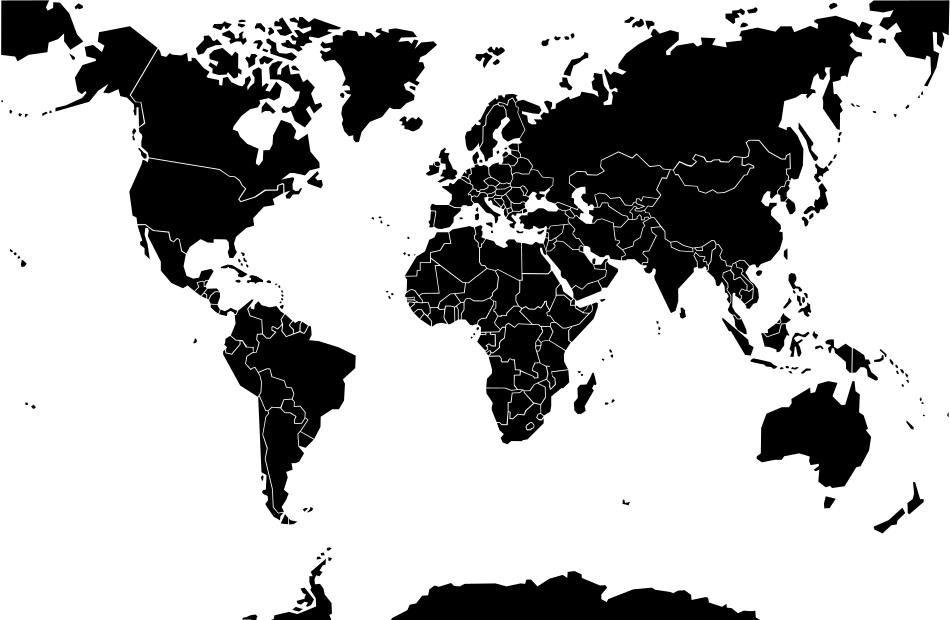 USAPeruBrazilPortugal
A short conversation is the simplest way to find out. We'll listen first, and only suggest something if it's likely to help.